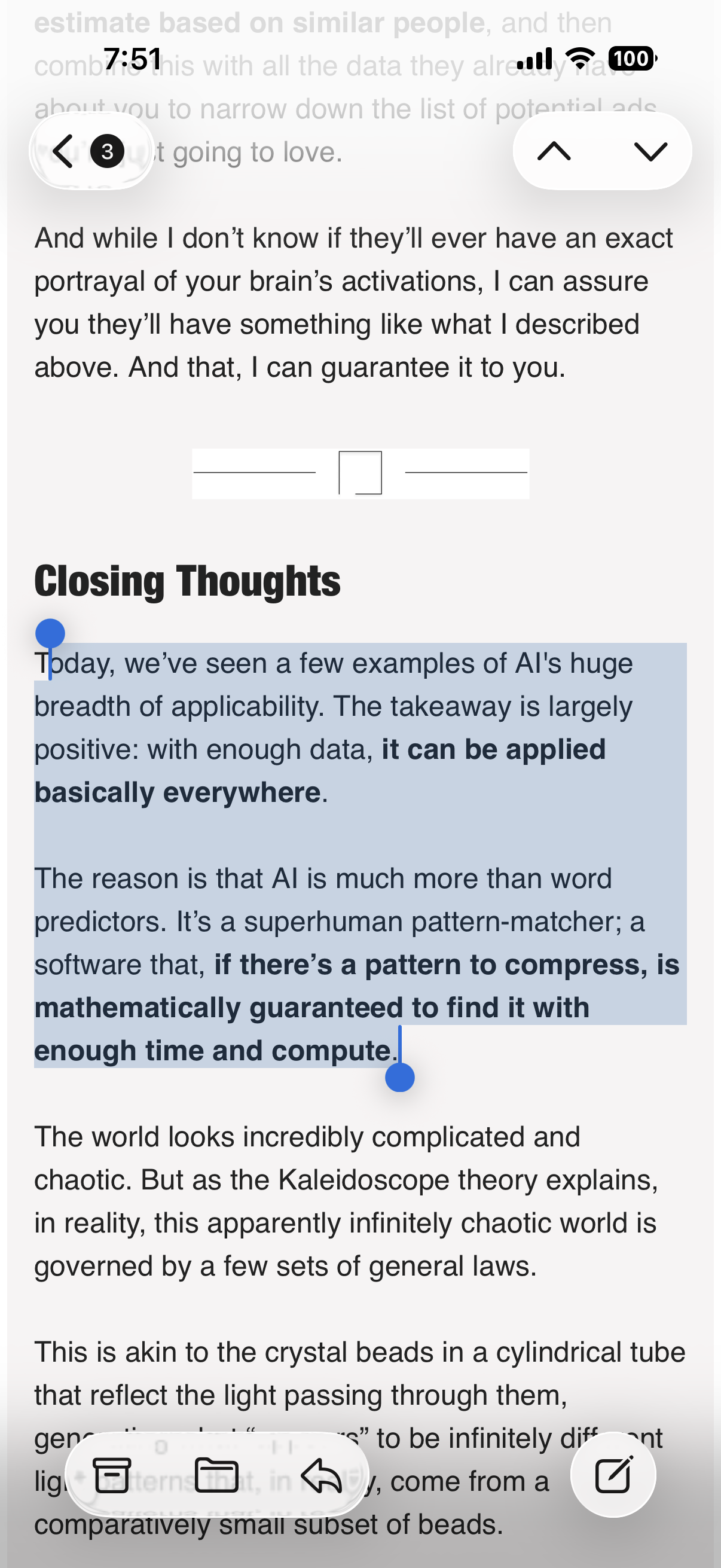
The screenshot says the quiet part clearly
The highlighted passage is about pattern compression. Strip away the drama and the idea is straightforward: AI is not limited to sounding fluent. It is very good at finding statistical structure inside messy data, especially when the same kinds of examples repeat over and over.
The stronger version of the claim should be handled carefully. Not every problem has clean data. Not every pattern is fair, stable, causal, or worth optimizing. But as a directional rule, it is hard to ignore: if math can model a signal, AI will probably get better at using it.
AI is pattern compression at scale
Modern AI systems work by turning huge piles of examples into compressed structure. That structure can predict the next word, classify an image, rank a search result, detect fraud, summarize a document, or estimate whether a resume and a job description belong in the same conversation. That last pattern is the practical core of AI job match scoring.
That is why the world keeps discovering new AI use cases in places that did not look like AI problems at first. The question is often not whether a domain feels complicated. The question is whether it contains enough repeated signal to learn from.
Hiring is full of compressible signals
Job search feels human, emotional, and chaotic because it is. But it also contains repeatable patterns everywhere: job descriptions reuse language, companies reveal preferences in requirements, recruiters screen for clusters of evidence, and candidates succeed when their proof maps cleanly to the role.
That does not mean AI should make every hiring decision. It means candidates should expect the search layer around hiring to become more mathematical every year.
- Job descriptions contain recurring skill, seniority, domain, and compensation signals.
- Resumes contain evidence patterns that can be matched, strengthened, or clarified.
- Recruiter screens often follow recognizable filters even when the wording changes.
- Company hiring behavior leaves timing and market signals across postings.
- Candidate feedback can tune future ranking so the system learns what fit means for one person.
The defensive move is to work with the pattern
If AI is going to find patterns in hiring, job seekers should not be forced to fight that shift with manual tabs and guesswork. They should have their own pattern engine: one that works for the candidate, not just for the employer.
That means better resume positioning, better job matching, better exclusion rules, better follow-up timing, and clearer explanations for why one role deserves attention while another should be ignored. Candidate-side pattern work also depends on teaching your job search scorer what your market actually rewards.
What this means for Atlas
Atlas is built on the belief that a job search contains enough signal to be improved dramatically. The system can compare your profile to a role, explain the score, adapt from feedback, and keep scanning the market while you are busy living your actual life.
The endgame is not to remove the human from the search. It is to give the human a sharper map. If the math can surface the pattern, the candidate should get to use that pattern first.